

The history of the Philippines
Philippine National Heroes












The Philippine Flags
Three flags were used by the Katipunan that was believed to be originally sewn by Andres Bonifacio’s wife, Gregoria de Jesus with the aid of Benita Rodriguez. These three are the most common variation of the Katipunan flags. The blood red background is the similar features of all three flags, including the letter K to represent the
Katipunan. In line with the Boy Scouts of the Philippines (BSP), the single “K” flag is not recognized as part of the BSP’s list of the Evolution of the Philippine Flag.
The Katipunan


The Katipunan Councils


There are two prominent factions of the Katipunan led respectively by Andres Bonificio and Emilio Aguinaldo.
Both gained support from different sectors of the Katipunan. Bonificio had his Magdiwang Council and Aguinaldo had his Magdalo Council. The Magdiwang Council had a sun with sixteen- (16) rays. It uses the similar red background of the Katipunan flag. Some historians say that the number of rays is indefinite however. This flag was believed to be the flag present when the Katipuneros tore their cedulas upon their discovery.
The Magdalo Council flag also used the sun. It had a preHispanic “K” superimposed on the center. The sun had eight- (8) rays to represent the first eight- (8) provinces that pledged its support to fight under Aguinaldo’s banner
and to start the Philippine revolution.
TheRevolutionary Government

The leaders of the Katipunan decided to fight under Aguinaldo’s banner. Aside from being formally educated,
Aguinaldo was winning his battles while Bonifacio was struck by a number of losses. For this same reason,
Aguinaldo’s flag was said to have become the basis for the design of the new flag of the revolutionary government – the Sun of Liberty. This same revolutionary government was responsible for ordering the execution of Andres Bonifacio. Bonificio was charged with treason for inciting rebellion against the new government. The flag was approved on March 17, 1897 in Naic, Cavite.
Battalion Flags



One of the most criticized part of the proposed evolution of the Philippine flag is the inclusion of three battalion flags of the Katipunan. Historians believe that if these flags were to be included into the evolution, other battalion flags should be considered as well. According to many historians, these flags never took the significance of a national symbol. These flag does not come in any significant order. The first flag was the flag of General Mariano Llanera who fought in the province of Bulacan, Tarlac, Pampanga, and Nueva Ecija. His flag was most famously called Bungo ni Llanera or Llaner’s Skull. Unlike most of the Katipunan banners, his was on a black background.
The second flag is that of Pio del Pilar, one of Aguinaldo’s most trusted Generals. Due to his many victories, his flag
was famously called Ang Bandila ng Matagumpay or The Flag of the Victorious. Superimposed on the famous red
background was a triangle (believed to be an equilateral triangle). Each corner of the triangle bears the letter K and on the triangle’s center is a rising sun with eight rays. The third and last flag is the flag of Gregorio del Pilar, the youngest general of the Katipunan and fondly called as the boy general. His flag was patterned after Cuba, already a former Spanish colony at the time. His flag was the first to use three colors. The flag took its last stand against the Americans in Tirad Pass, Ilocos Sur, defending the retreating armies of Aguinaldo.
The Real Evolution


Philippine Presidents
Copyright ©2012-2013 Property Of The Knowledge Team
All Rights Reserved
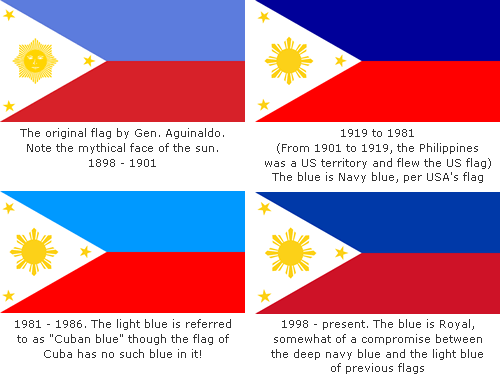
The symbols of the flag
an eight rayed sun
three golden stars
a red stripe
a blue stripe
a white triangle
The sun represents the beginning of a new era of self determination.
The 8 rays on the sun stand for the 8 provinces that rose in revolt against Spanish rule in the late 19th century.
The 3 stars stands for the 3 principal geographic areas of the country; Luzon, the Visayas and Mindanao.
The colours in the flag
The colour white represents peace and purity
The red stripe represents courage and bravery
The blue stripe is for noble ideals
One country, two flags!
Probably unique in the world is that a country has a flag for peacetime and a flag for wartime. The flag showed above is, let us hope, the one we'll see always. Blue on the top stands for peacetime. In wartime the flag will have the red stripe on the top.
The Philippines in earlier times
The First Inhabitants 40.000 years ago
It is thought that the earliest inhabitants of the Philippines lived some 40000 years ago. On Palawan, the long and small island in de western Visayas, human bones were found dating to about 22.000 years ago. Stone tools from ancient times were found too on Palawan. The age of the tools is estimated to be about 30.000 years old. A analyses showed that the tools have similar features as tools which were found on Kalimantan (Indonesia).


The original people of the Philippines were ancestors of the people known today as Negritos or Aeta. They are very small people with a dark skin and curly brown hair.
The Aeta came 13000 - 10000 years ago from the Asian continent. In earlier times they lived widespread throughout the Philippines. Today they are living in the remote highland areas of Luzon, Palawan, Panay, Negros and Mindanao. About 2300 years ago Malayan people arrived from the mainland in the Philippines and brought a more advanced culture; dairy, iron melting and production of iron tools, pottery techniques and the system of sawah's (rice fields).
In the tenth century Muslim traders come from Kalimantan (Indonesia) to the Philippines. A few centuries later, the Islam spread out in the southern part of the Philippines. Until now, the Islam is strong rooted on Mindanao and the other (smaller) islands of the southern part of the Philippines.
The arrival of the first Spaniards

In 1521 the Spanish period started with the arrival of a small fleet in the coastal waters of Mactan island, just east of Cebu island. It was Fernao de Magelhaes (Ferdinand Magellan), a Portuguese in service of the Spanish King. He claimed the country for the Spanish King.
Lapu Lapu, the national hero

There was great resistance of the local people. In the battle that took place that day, the locals with their leader Lapu Lapu succeeded in forcing the Spaniards to retreat to their ships, after their leader, Magellan, was killed by the spears of the Lapu Lapu warriors. Lapu Lapu became the first Filipino hero.
The Spanish colonial period
Resistance of the locals
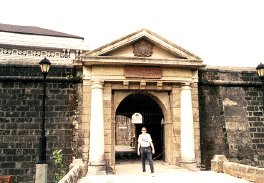
After the Spaniards succeeded in 1556 to break the last good organized resistance, a long period of Spanish influence followed. The Spaniards ruled the country, brought the Christian religion to the country and were responsible for a lot of colonial and religious buildings throughout the country.
The results can still be seen in places as for instance Cebu City and Manila.
Revolts against the colonizers
The Spanish colonial period wasn't without resistance of the Filipinos. On the contrary. There was a succession of revolts against the European colonizers. Aguinaldo was the great leader of the big revolt of 1896. However, the Filipino rebels didn't succeed to defeat the armed Spaniards at that time. A helping hand came a few years later from the Americans.
Liberty, brought by the Americans?
At the end of the nineteenth century, on April 25,1898, the United States declared war on Spain. The main reason was that the U.S. battle ship Main was blown up in the harbor of Havana. The United States thought Spain blew up this ship with a mine. (However, it was proved that the Main blew up due to coal dust). The American navy decided to attack the Spanish fleet in the Philippine waters. The battle took place in Manila Bay. On May 1 in 1898 the Spanish fleet was destroyed. After 327 years under Spanish rule, the Philippine people thought that they won independence at last. The Americans however, thought quit different about that at that time.

The Philippines, sold for a amount of less
than 20 million dollars
After the end of the American-Spanish war in 1898,
the Spaniards sold the Philippines and other colonial properties for 20 million dollar to the Americans. Aguinaldo didn't want to accept American rule and proclaimed the first Philippine Republic.
The Americans decided that the Filipinos were not
yet capable to be independent. A hostile period started. The United States needed more than 125.000 soldiers to subdue the Philippines. The Philippine rebels were forced to retreat and were driven into northern Luzon. From here they started a guerrilla. This "Philippine War of Independence" continued for two years and ended when Aguinaldo was captured on March 23, 1901.
Only sporadic resistance continued until 1903.
Aguinaldo
Changes in the American period
Consequences of the American colonial rule
During the Spanish period the Spaniards had given enormous land properties to the Catholic church. One of the first things the Americans did was to take care for the redistribution of these land properties. To do so they first had to pay an amount of US $7.2 million to the Vatican in 1904. The small farmers or tenants didn't get any land however. The land became property of some large landowners. Most of the small farmers couldn't pay the asked price or couldn't prove that they were the former owners of the land.
The economic development during the 'American period' was rather typical colonial. The Philippine economy was strongly related to and depending on the United States. The Philippine economy was focused on mining and exporting crops. Industrial growth didn't take place.
Quezon, the first Philippine president
The Philippines was controlled by the Americans from
1900-1942. In 1934 an act was established, which made
it possible that the Philippines could have a
"Commonwealth of the Philippines".
The first president of this Commonwealth was Manuel Quezon. The first president was given certain power
for some internal affairs.
The Japanese occupation
The Americans were still in the Philippines when the next
foreign ruler came. Japan. The Japanese army and rulers
occupied the Philippines from 1942 - 1944.

The first step to liberation
In October 1944 the American general Douglas Mac Arthur landed with his troops at the east coast of Leyte, one of the bigger islands in the central part of the Philippines.
This was the first step in the total liberation of the country. With 700 vessels and 174,000 army and navy servicemen, McArthur arrived in the Philippines. In December 1944, the islands of
Leyte and Mindoro were cleared of the Japanese army.
Many casualties
The casualties of the Americans in this operation is estimated 4000 - 6000.
Filipino casualties: estimated about one million!
Freedom at last!
The Philippines was granted it's independence in 1946. Freedom at last, 148 years later than the freedom which was written down by Julian Felipe in the Philippine anthem called "Lupang Hinirang".
The Republic of the Philippines was proclaimed on July 4, 1946.

Influence of the Catholic religion
Typical for the Philippines are the many festivals and processions.
The explanation for the most of all these fiestas has to be found in the domination of one specific religion in the Philippines. The majority of the cultural celebrations is closely related to the Catholic religion. Nearly 90% of the Filipinos are Roman Catholic. If you like fiestas, it is really worth to visit the Philippines, especially in January, April, May and June. The most known and biggest fiestas take place in these months.
The most known fiestas
For the Filipinos themselves, every year the festivals and processions are days of great joy and happiness. Fiestas or any community celebration usually feature music, dancing, and food feasts. The most known are the procession of the Black Nazarene, the Ati-Atihan, the Sinulog, the Flores de Mayo and the Santa Cruzan.
The colourful dress is most of the time not traditional. To see really traditional clothes, you have to visit the remote areas on Luzon and Mindanao for example.
Colourful festivals and processions

Ati - Atihan
A three-day fiesta in the third week of January on the island of Panay (Visayas)
The wildest among Philippine fiestas!
The festival is a Catholic festival in honour of Santo Niño.
During the last day of this festival (fiesta), a parade is characteristic, with celebrants who paint their faces black, wear sometimes masks and rather exceptional costumes.
The origin of the Atis dances dates from the period before the Spaniards arrived on Panay. The typical dance belonged already to the local Atis people in that pre-colonial period.

Sinulog
In January, in honour of the miraculous image of the Santo Niño.
In colourful costumes people of Cebu make their way through the streets while dancing the Sinulog, a traditional and ritual dance.
The dance is accompanied by the sound of the drums: all the time moving
two steps forward followed by one step backward.
The Sinulog was already danced by the natives long before the Spaniards arrived in the Philippines. It was only in 1980, that the first Sinulog parade was organized. From then on it grew up to an enormous festival with a very large parade.

Flores de Mayo
(Flowers of May)
A month-long festival in May in honour of the Holy Mary
Flores de Mayo
is a Catholic festival introduced by the Spaniards. The last day of the festival is highlighted by a pageant called Santa Cruzan.
The Santa Cruzan
is a procession in honour of the finding of the Holy Cross in the year 326 A.D. by Reyna (Queen) Helena, mother of the Roman emperor Constantine the Great. It was the wooden, Holy Cross, on which Jesus Christ was supposed to have been nailed. Long time ago Flores de Mayo and the Santa Cruzan were blended together in one festival.

Black Nazarene
The largest procession in the country through the streets of Quiapo in metro Manila.
Every year on the 9th of January and on Good Friday, barefooted men carry a life-sized statue through the streets of Quiapo in Metro Manila.
The procession dates from the 17th century.
Thousands of men parade through the streets with the black wooden statue of Jesus (of Nazarene).
Everybody who is in the neighbourhood of the statue tries to touch the statue. People believe that a miracle can happen after touching it.